Summary
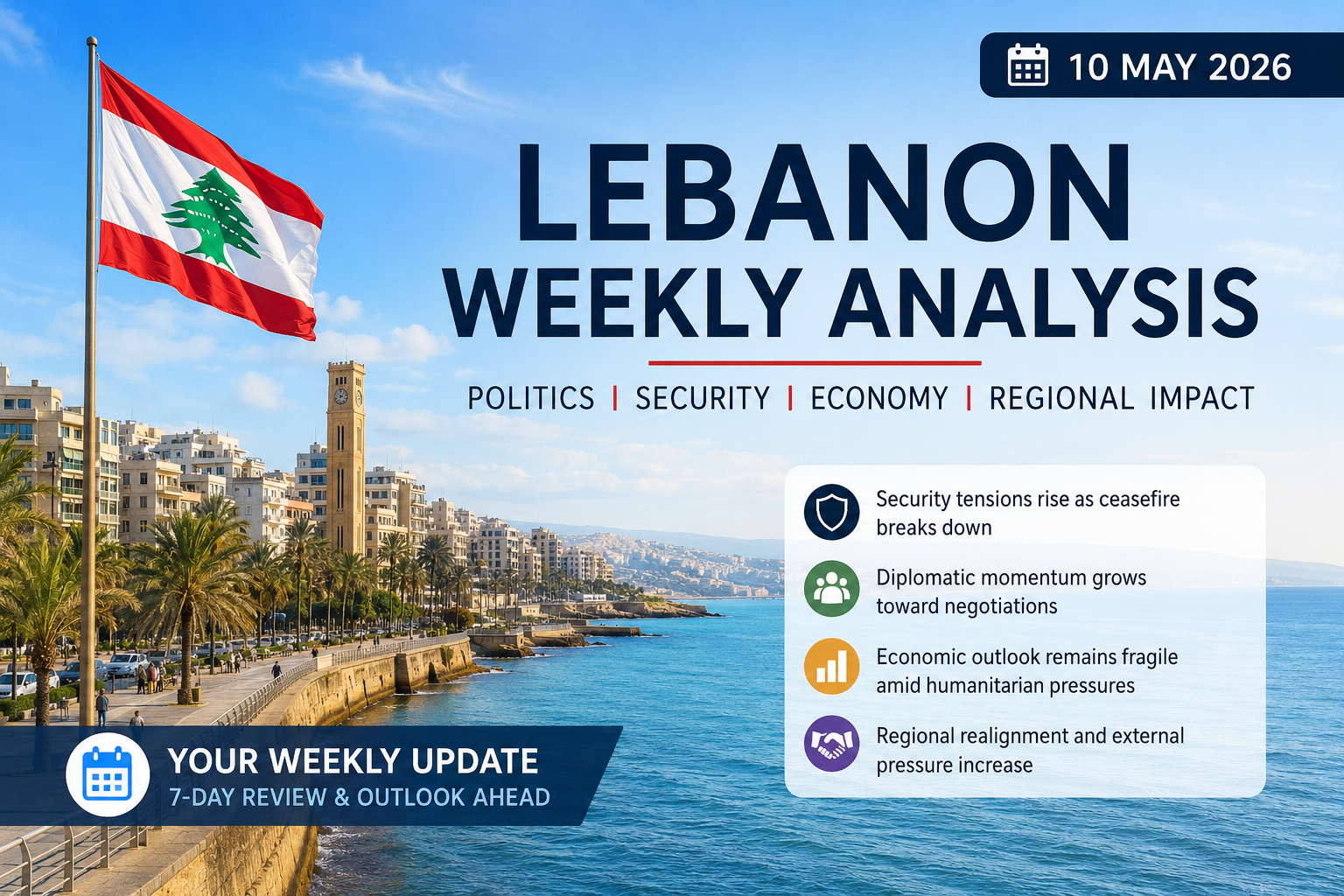
- The April US-brokered ceasefire has effectively collapsed, with renewed Israeli strikes on Beirut’s southern suburbs and intensified Hezbollah rocket and drone attacks.
- US-mediated Lebanon–Israel talks next week are now a critical test; failure risks wider escalation and deeper Lebanese instability.
- Lebanon’s political leadership is increasingly backing diplomacy and negotiations, exposing growing tension between state institutions and Hezbollah’s military posture.
- Lebanon’s economic outlook remains fragile despite currency stability, with displacement, infrastructure damage, and humanitarian pressures worsening.
- Syria is re-emerging as a key strategic partner for Lebanon on energy, border security, and transport, reflecting wider regional realignment.
A. Political Developments
President Joseph Aoun and Prime Minister Nawaf Salam focused this week on diplomacy and crisis management as preparations intensified for Lebanon–Israel talks in Washington on 14–15 May. The discussions are expected to address ceasefire consolidation, Israeli withdrawal issues, displaced persons, and border security.
A notable political shift emerged as the Maronite Church and several mainstream factions publicly supported internationally backed negotiations. Salam also reiterated that weapons should ultimately be confined to the Lebanese state — a subtle challenge to Hezbollah’s autonomous military role.
At the same time, signs of friction between Amal and Hezbollah began appearing publicly, potentially weakening the appearance of unified Shiite political backing for continued confrontation.
Salam’s visit to Damascus also signaled rapidly improving Lebanese–Syrian relations, particularly on energy, transport, border security, and detainee issues.
Why it matters
Lebanon’s political crisis is increasingly defined by a widening divide between state institutions seeking de-escalation and Hezbollah’s continued military engagement with Israel.
The growing acceptance of negotiations reflects recognition among Lebanese elites that prolonged conflict is economically and politically unsustainable. Syria’s renewed role also highlights changing regional dynamics after the collapse of Assad-era structures.
Direction
Political fragmentation continues, but momentum toward diplomacy is slowly increasing.
B. Lebanon Security Situation
Security conditions deteriorated sharply over the past week. Israel struck Beirut’s southern suburb and intensified attacks across southern Lebanon, reportedly targeting Hezbollah commanders and logistics infrastructure.
Hezbollah responded with rockets and explosive drones into northern Israel. Israeli evacuation warnings expanded across several southern villages, adding to mass displacement estimated at over one million people.
Civilian casualties continued to rise, including highly symbolic incidents affecting displaced families and Christian communities in southern Lebanon. Pope Francis’ outreach to border clergy reflected growing international concern over humanitarian and religious impacts.
Why it matters
The ceasefire breakdown has created a dangerous and unpredictable security environment. Israel appears focused on degrading Hezbollah’s operational capacity while maintaining pressure through buffer-zone dynamics in southern Lebanon.
Although neither side appears to seek full-scale war, the risk of miscalculation is rising significantly, particularly following strikes near Beirut and increasing drone exchanges.
Direction
The trajectory is toward rising but still contained instability.
C. Economic Outlook and Financial Crisis
The Lebanese pound remained relatively stable near 89,500 LBP/USD, but broader economic recovery remains absent.
Government measures focused on reducing social pressure through utility payment relief, higher family allowances, and tighter banking regulations aimed at improving financial transparency and supporting removal from the FATF grey list.
The most important economic development was the proposed regional gas arrangement linking Jordan, Syria, and Lebanon through the Arab Gas Pipeline to improve electricity supply.
Meanwhile, humanitarian pressures deepened. Agricultural losses in southern Lebanon increased sharply, aid funding remains insufficient, and risks to food security and public services continue to grow.
Why it matters
Currency stability masks continued structural collapse. The gas transit initiative could improve electricity supply if implemented, but Lebanon’s long history of failed energy deals limits confidence.
Conflict-related displacement and infrastructure damage continue undermining investor confidence and increasing social pressure.
Direction
Fragile stabilization continues without meaningful recovery.
D. Regional and International Context
The United States increased diplomatic engagement ahead of next week’s Lebanon–Israel talks. US Secretary of State Marco Rubio publicly blamed Hezbollah and Iran for Lebanon’s instability and emphasized support for the Lebanese state rather than Hezbollah.
European engagement also increased through humanitarian support and customs reform discussions.
Syria’s strategic importance to Lebanon is growing rapidly, particularly regarding energy transit and border coordination.
Why it matters
Lebanon is increasingly caught between regional competition involving Israel, Iran, Syria, and the United States. International actors are placing greater emphasis on strengthening Lebanese state institutions while isolating Hezbollah politically and financially.
Direction
External pressure on Hezbollah is increasing while regional polarization continues.
What Next
- Failure of next week’s Washington talks could trigger further Israeli escalation and expanded displacement in southern Lebanon.
- Watch for increased Hezbollah drone attacks if Israeli strikes continue targeting senior operatives or civilian-linked areas.
- Monitor signs of deeper Amal–Hezbollah political divergence.
- Progress on Syria-linked gas transit could modestly improve Lebanon’s economic outlook.
- Continued humanitarian deterioration risks further weakening public confidence in state institutions.
Comment
Lebanon Analysis suggests the country is entering a more structurally unstable phase where political paralysis, economic strain, and security escalation are increasingly interconnected.
Current dynamics point toward prolonged contained conflict rather than immediate full-scale war, but escalation risks are rising. Without a durable ceasefire mechanism and stronger Lebanese political consensus around state authority, instability is likely to persist.

Leave a Reply