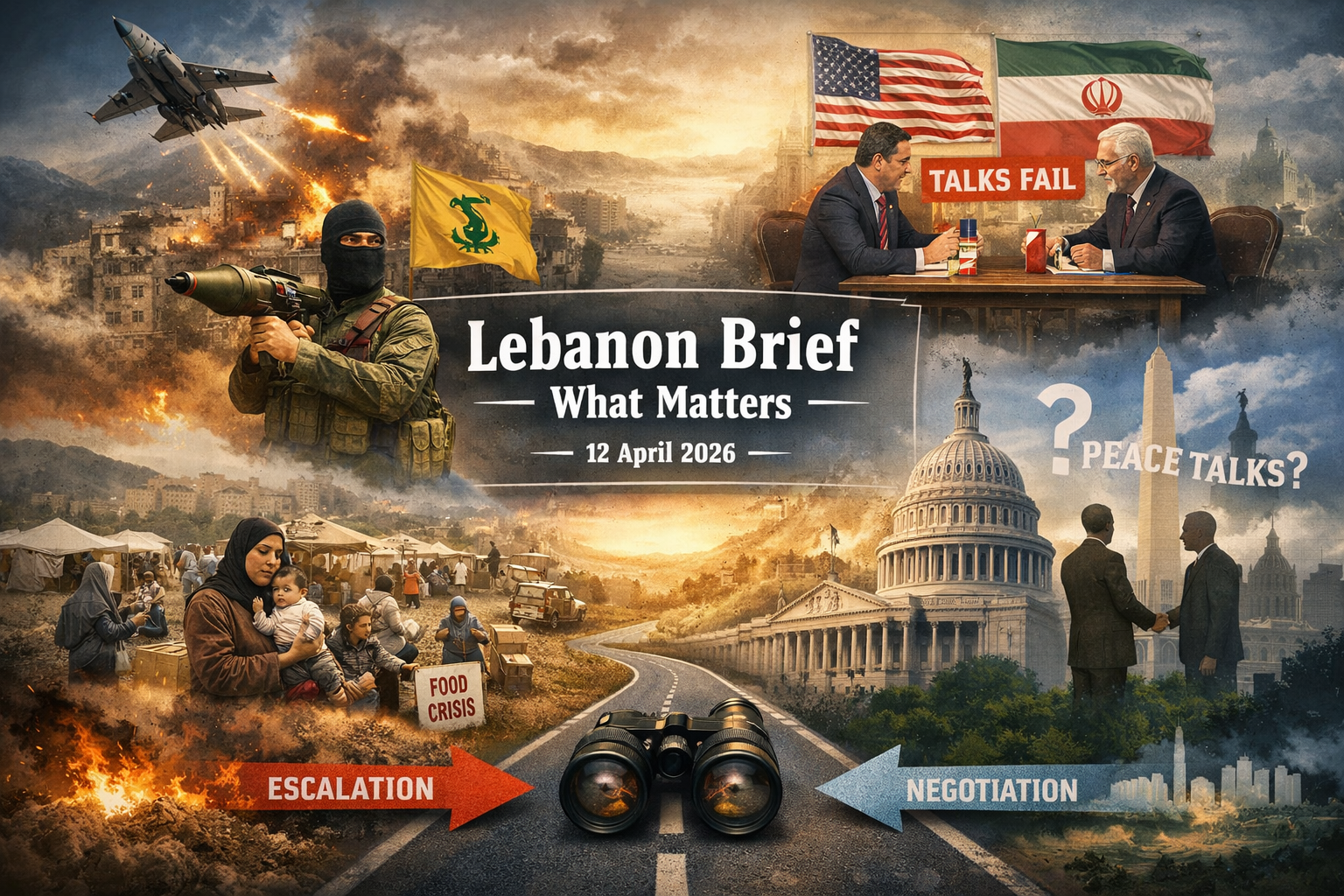
Summary
- Israel sustains strikes in southern Lebanon while reducing attacks on Beirut, signalling tactical restraint under U.S. pressure.
- April 8 Escalation (Key Lebanon Analysis Event), a major surge in Israeli operations targeting Hezbollah across Lebanon.
- U.S.–Iran talks ended without agreement, leaving the regional ceasefire framework fragile.
- Preparations for Lebanon–Israel talks in Washington advance, but ceasefire sequencing remains unresolved.
- Hezbollah’s Iran-backed position continues to constrain Lebanese state decision-making.
- Humanitarian and economic pressures are accelerating across Lebanon.
1. Security Situation: High Intensity, Controlled Escalation
- Israeli operations continue at scale in southern Lebanon, with sustained strikes and ground activity.
- Objective remains degradation of Hezbollah capacity and possible buffer zone creation
- Military pressure continues to underpin Israel’s negotiating posture
- Strikes on Beirut and southern suburbs have decreased following earlier large-scale bombardment.
- Likely reflects U.S. pressure to contain escalation
- Indicates tactical—not strategic—restraint
- Hezbollah continues cross-border attacks into northern Israel.
- Confirms sustained bilateral engagement rather than one-sided operations
- Escalation risk remains high
- Casualties continue to rise, with over 2,000 reported killed since early March.
- Civilian impact is increasing diplomatic pressure
- Trendline remains upward despite reporting inconsistencies
2. April 8 Escalation (Key Lebanon Analysis Event)
On April 8, Israel conducted one of its largest coordinated strikes against Hezbollah since the 2024 pager attacks, targeting hundreds of operatives across multiple command sites. Israeli leadership described the operation as a major blow to Hezbollah, while Lebanese authorities condemned it as a “massacre” following a strike in Beirut.
- Represents a significant spike in operational scale and coordination
- Demonstrates Israel’s willingness to escalate while diplomacy remains active
- Reinforces military pressure as Israel’s primary strategic lever
- Signals that Beirut remains within scope despite efforts to contain escalation
3. Diplomatic Track: Movement Without Convergence (Lebanon Analysis)
- U.S.–Iran talks ended without agreement after extended negotiations.
- Leaves ceasefire framework unresolved
- Lebanon remains central to broader regional dynamics
- Iran links de-escalation to a Lebanon ceasefire.
- Positions Lebanon as a key bargaining arena
- Limits Lebanese autonomy
- Preparations for Lebanon–Israel talks in Washington continue.
- Potentially historic engagement
- Core disagreement persists:
- Lebanon demands ceasefire first
- Israel rejects preconditions
- Early diplomatic contacts show momentum but remain fragile.
- Sequencing disagreements risk stalling talks
4. Lebanese Internal Dynamics: Constraint and Fragmentation
- Lebanese state authority remains constrained by Hezbollah’s independent military role.
- Strategic decisions effectively externalized to Iran
- Hezbollah rejects direct negotiations with Israel.
- Creates a structural barrier to diplomacy
- Domestic divisions are widening.
- Pro- and anti-negotiation protests emerging
- Political fragmentation deepening
- Government is prioritizing internal stability.
- Limiting protests and delaying political activity
5. Humanitarian and Economic Pressures: Lebanon Under Strain
- Displacement exceeds one million people.
- Food insecurity is rising due to supply disruptions and access constraints.
- Inflation is accelerating, particularly in basic goods.
- Humanitarian access remains limited.
→ Lebanon is moving toward a deeper humanitarian crisis if conflict persists.
What Next (Lebanon Analysis – Forward Indicators)
- Continued southern strikes + reduced Beirut targeting → controlled escalation persists
- April 8-style large-scale strikes recur → signals escalation dominance over diplomacy
- No ceasefire before Washington talks → symbolic diplomacy, limited outcomes
- Increased U.S. pressure → potential further Israeli restraint
- Renewed U.S.–Iran engagement → Lebanon enters own negotiations
- Rising domestic unrest → constrains Lebanese participation
Comment (Lebanon Analysis)
The April 8 escalation underscores a shift toward intensified but managed conflict. Military pressure remains Israel’s primary lever, while diplomacy lacks convergence. Lebanon’s structural constraint—its inability to act independently of Hezbollah—continues to block meaningful progress. The near-term outlook remains controlled escalation rather than resolution.

Leave a Reply